BASICS OF SUSPENSION
To begin this training program, you need to know some basic information. First, you should know that the tyres and wheels make vehicle motion possible. The chassis connects the tyres and wheels to the vehicle’s body. The chassis consists of the frame, suspension system, steering system, tyres and wheels.
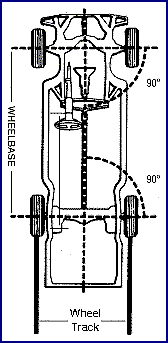
When discussing a vehicle’s chassis, the side-to-side distance between the centreline of the tyres on an axle is called track. The distance between the centre of the front and rear tyres is called wheelbase. If the vehicle is in proper alignment, the wheels will roll in a line that is parallel with the vehicle’s geometric centreline.
Vehicle geometry, suspension, and steering design all affect the “handling” of a vehicle. To better understand the term handling, we can address the following fundamentals that contribute to good handling:
ROAD ISOLATION – is the vehicle’s ability to absorb or isolate road shock from the passenger compartment.
DIRECTIONAL STABILITY – is the ability of the vehicle to maintain a directed path.
RETURNABILITY – is the ability of the vehicle to return the front wheels to straight ahead after turning.
TRACKING – is the path taken by the front and rear wheels.
CORNERING – is the ability of the vehicle to travel a curved path.
So, to a great extent, handling depends on optimising the vehicle’s suspension dynamics, or dynamic control. This means that when a vehicle is in motion, all the components in the suspension system work together effectively to provide tyre-to-road contact. The amount of this traction force between the tyres and the road is the major factor in how well a vehicle can manoeuvre through corners, or as it stops and accelerates.
The components of the suspension system perform six basic functions:
- Maintain correct vehicle ride height
- Reduce the effect of shock forces
- Maintain correct wheel alignment
- Support vehicle weight
- Keep the tyres in contact with the road
- Control the vehicle’s direction of travel.
However, in order for this to happen, all of the suspension components, both front and rear, must be in good working condition.