Shock Absorbers Explained
In their simplest form, shock absorbers are hydraulic (oil) pump like devices that help to control the impact and rebound movement of your vehicle’s springs and suspension. Along with smoothening out bumps and vibrations, the key role of the shock absorber is to ensure that the vehicle’s tyres remain in contact with the road surface at all times, which ensures the safest control and braking response from your car.
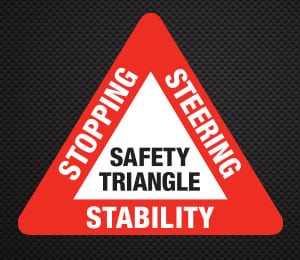
It is what we call the Monroe Safety Triangle, encouraging motorists to check tyres, brakes and shock absorbers with every service to ensure optimum stopping, steering and stability.
What do shock absorbers do?
Essentially, shock absorbers do two things. Apart from controlling the movement of springs and suspension, shock absorbers also keep your tyres in contact with the ground at all times. At rest or in motion, the bottom surface of your tyres is the only part of your vehicle in contact with the road. Any time that a tyre’s contact with the ground is broken or reduced, your ability to drive, steer and brake is severely compromised.
Despite popular belief, shock absorbers do not support the weight of a vehicle.
SHock Absorbers In more detail
Firstly, a little bit of science. Shock absorbers work by taking the kinetic energy (movement) of your suspension and converting it to thermal energy (heat) that is then dissipated into the atmosphere through the mechanism of heat exchange.
But it’s nowhere near as complicated as it may sound.
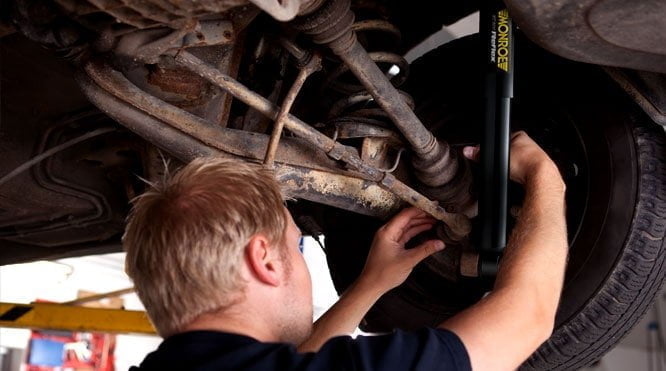
As mentioned, shock absorbers are basically oil pumps. A piston is attached to the end of a piston rod and works against hydraulic fluid in the pressure tube. As the suspension travels up and down, the hydraulic fluid is forced through orifices (tiny holes) inside the piston. Because the orifices only allow a small amount of fluid through the piston, the piston is slowed which in turn slows down spring and suspension movement.
Shock absorbers automatically adjust to road conditions because the faster the suspension moves, the more resistance they provide.
Types of shock absorbers
Although all shock absorbers do the same job, different types of vehicles and suspension designs require different types of shock absorbers which can appear radically different.
No matter the application, all shock absorbers fit into one of three broadly defined types conventional telescopic shock absorbers, struts or spring seat shocks.
Conventional telescopic shock absorbers
This is the simplest type of shock absorber and is generally replaced rather than repaired.
This type of shock absorber can be found on both front and rear suspension systems and is relatively inexpensive.
Strut type shock absorbers
Although they do the same basic job, struts replace part of the suspension system and must be more ruggedly built to cope with greater loads and forces.
Although most commonly seen on the front and rear of small to medium cars, larger cars are now tending towards strut based suspension design. The strut category is further divided into sealed and repairable units.
As the name suggests, sealed units are designed to be fully replaced, whilst repairable (McPherson) struts are able to be fitted with replacement strut cartridges.
Spring seat shocks
The spring seat type shows characteristics of both telescopic and strut type shock absorbers. Like struts, a spring seat shock is a suspension unit and damping device in a single unit.
Unlike struts however, they are not designed to be subject to high side loads. Built using similar components to conventional shock absorbers, spring seat shocks are also sealed requiring full replacement.
How do they work?
Shock absorbers are pump-like devices which keep your vehicle’s tyres in contact with the road surface by controlling the rebound of its suspension springs. As long as your vehicle’s tyres remain in contact with the road, steering, road handling and braking response will be optimal, helping to keep you safe.
Shock absorbers and suspension
Monroe’s reputation for innovation comes down two three things. Testing, testing and testing. As you’ll see, we make sure our products performance across braking, handling and stability is always 100%.
You’re also about to discover how your control relies on Monroe’s Mounting and Protection Kits. So every time you check your shocks & suspension… check your vital Monroe mounts and compression bumpers too.